Tuesday, December 29, 2020

J=K Gibson Confirmed!

My days of collecting George Gibson cards go back to about 2006 or so. Since then I've tried to maintain a checklist of every Gibson card out there. At some point I should move it over to something more accessible like TCDB, but until then, it'll remain in a Google sheet (found here). 

Aside from back variations introduced by Helmar, which I do a generally poor job of keeping track of, additions to the Gibson checklist are generally few and far between.

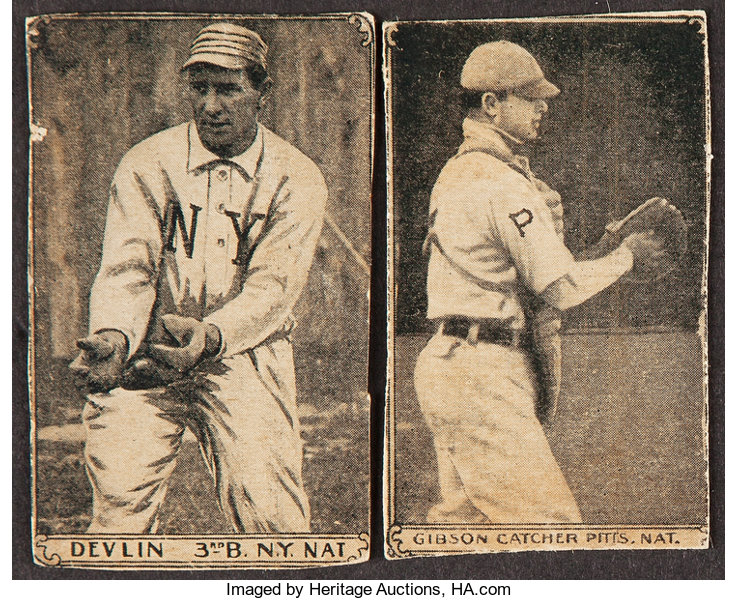
But this year,  a card I had never seen before (in fact, I wasn't even convinced it existed) hit the auction block not once, but twice. Both times it was offered by Heritage, and so now, the checklist confirms that a 1912 J=K George Gibson exists!

Shown first, is the copy that Heritage Auctions auctioned back in June of this year -- my first time ever actually seeing an example of the Gibson card. Depending on how well you know your Gibson cards, it may remind you of his M101-2 or E125. This lot sold for $2100 including the buyer's premium.

Then, as if this card wasn't rare or something, Heritage Auctions auctioned another, better example, just this past December:

And just to show you have unpredictable prices are of, well, obscure players on obscure issues, this card, the obviously much nicer grade, though not as part of a lot, sold for $600 with the buyer's premium.

Sadly, neither example found its way into my collection. But maybe one day ;)

For now, I'm just happy to update the checklist and know the card actually exists!

Sunday, October 11, 2020

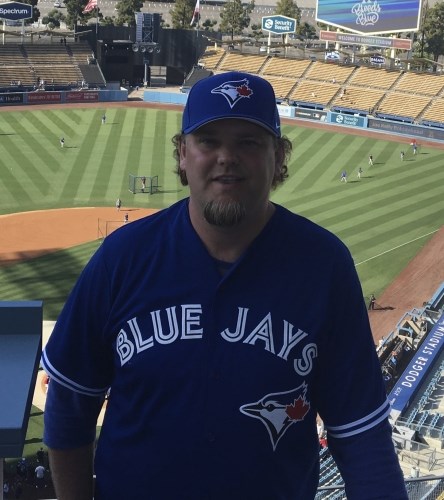
Martin Healy Jr. (1977-2020)

Martin Healy Jr. (1977-2020)
I have been a member of net54baseball.com since it's inception. Years ago I was a lot more active on the site, and it wasn't uncommon to get messages out of the blue from other members on the site about something related to George Gibson.

Such was the case on January 29, 2015, when 'MartyFromCanada' reached out to introduce himself. It didn't take long for us to realize we had a lot of the same baseball interests, especially Canadian baseball, and Canadian great George Gibson. We regularly traded messages, tipping each other off about auctions or interesting articles and just talking baseball in general.

This continued until May, when Marty emailed to ask how much research I had done on George Gibson, and whether or not I felt there was enough content for a book. Short answer: yes. Prior to having met Marty I had set out to research George Gibson with the intention of writing a book. After about a year, I put my research on hold as life and work got busy. But Marty's note reignited that research. I shared everything I had collected to that point, and before long the two of us were in full force expanding on that research to write a book.

Fast forward to March of 2020, and the book was released. Getting a physical copy in the mail was a cool experience. Admittedly, the timing probably could not have been worse, as it was literally the same week that Ontario went into shutdown due to the global pandemic. In the grand scheme of things, the book was not important, though, and we both knew that. Still, seeing years of work come to fruition was rewarding. And if we had to wait a few months before we could officially mark the release of the book so be it. We had already waited this long. What's a few more months, right?

Well, a few weeks ago, I got a call from Marty's Dad.

Marty passed away the night before in his sleep. He is gone.

So a few more months, it seems, is not nothing.

Gone is our chance to meet in person, and celebrate reaching our goal.

Gone is my chance to shake Marty's hand, to congratulate him on becoming a published author.

Gone is our chance to travel to London, and deliver copies of the book in person, to George's family.

Gone is my friend.

The past few weeks have been tough. Five years ago, Marty and I set out to write a book. We talked nearly daily, be it via text, email or over the phone. Along the way we got to know each other pretty well. The simple truth is that we became friends. I don't think either of us could have predicted that it just happened. It's hard not to like a guy like Marty. So friendly. So down to earth. So kind. And my god, did he know his Canadian baseball history. Kevin Glew recently described it as 'encyclopedic.' I can't think of a better word for it.

Of course, I was aware that he was living with congestive heart failure. To say that was in the back of our minds as we wrote the book would be a lie. Marty was very open about it. He would say to me, "I want to see this book published before I die."

And he did. He got his "author copies" the same day I got mine. We talked on the phone that day. He was excited, I was excited. It was a good day.

So while I will openly admit that I am saddened by his passing, I can't help but look fondly on the fact that his name is firmly planted on the cover of a book about Canadian baseball history, and that he got to see it happen. To be honest, mostly I just feel thankful about the whole thing.

Thankful that somebody else was so intrigued by an obscure baseball player like George Gibson.

Thankful that he found his way to net54baseball, and decided to message me that day in January, 2015.

Thankful that he was equipped with the same ambition to attempt writing a book, and the same ignorance about just how much work it would be.

Thankful that McFarland Publishing agreed to publish our work.

Thankful that we got the book done, and even more thankful about the friendship that formed with each chapter we wrote. Along the way, I got to meet some of Marty's family, and he met mine. My wife will confirm everything I'm saying about what a great person Marty was. And my son, the Yankees fan, will tell you how much he enjoyed trading barbs with Marty, a Blue Jays fan. What my son can't tell you is the number of times Marty mailed him an envelope out of the blue of Aaron Judge baseball cards, because we lost count.

I'm gonna miss talking Canadian baseball with him.

I'm gonna miss catching baseball games with him. 

I'm gonna miss meeting up with him at the annual CCBR baseball conference.

If I stay sad for a while yet about Marty's passing, I think I have good reason. But as you can see, I also have a lot to be thankful for. And I won't soon move on from that either.

Marty my friend, thank you, it has been an honour. Rest in pace.

Richard.
Monday, May 25, 2020

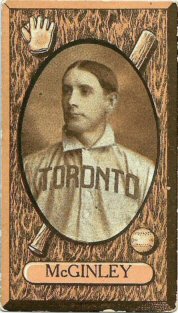
C46 Degrees of Separation: James McGinley

Many months have passed since my first (and until now, only) post trying to connect George to a player in the C46 set. It's probably about time to try to link George to another, don't you think?

Our focus today, is the second card in the set, that of James McGinley. McGinley, who was born in Groveland, MA on October 2, 1878, had a professional playing career that spanned fourteen seasons. He spent parts of two seasons -- appearing in 4 games total -- in the major leagues, with the St. Louis Nationals.

James McGinley's professional career began with the Haverhill Hustlers of the New England League in 1901. He remained with that club for 4 seasons, before being drafted by St. Louis in the summer of 1904. McGinley remained with Haverhill until the New England League season ended, and then joined St. Louis. He appeared in his first game on September 22, 1904. McGinley pitched the back half of a double header against the Boston Beaneaters, and came away with the complete game 4-2 victory. He pitched twice more in 1904, and ended the season with a 2-1 record. It was enough to get invited back for 1905.

The 1905 season for McGinley was short. He appeared in one game, against the Chicago Cubs on May 5th. He lasted three innings, gave up six runs, and was replaced in the fourth inning by Canadian Win Kellum. I'd love to find a connection from Gibson to Kellum and call it a day, but I don't have one, yet. So we'll keep going.

On May 10th, McGinley was released back to the New England League, and just like that, his big league career ended. Since George Gibson didn't debut in the majors until July, there was never a chance for the two to cross paths as players in 1905.

It is unclear where McGinley spent the rest of 1905, but in 1906 he joined Toronto of the Eastern League. McGinley remained with Toronto through 1911. It's very possible, even likely, that Gibson and McGinley crossed paths in 1911, when the Pirates played an Exhibition Game in Toronto late in the season, but it wasn't in the game. McGinley doesn't show up in the box score.

Even if McGinley wasn't at the game, or wasn't even still in Toronto (1911 was his last season with the Maple Leafs), it'd be easy to link Gibson to McGinley thorough one of the players that did appear in that game in 1911, but I thought I'd try to be a bit more creative.

When McGinley played in his final big league game in 1905, playing second base for the St. Louis club was Winfield, Kansas native Josh Clarke. If you know your Pirates history, then both the town Winfield, and the name Clarke will sound familiar. And they should. Josh Clarke, of Winfield, Kansas is the younger brother of Pirates Hall-of-Fame, and fellow Winfield, Kansas native Fred Clarke.

There you have it. Considering how long Fred Clarke and George Gibson played together, I'm sure Gibson crossed paths with Josh Clarke at some point, but for the sake of this exercise, connecting Gibson to McGinley through the Clarke brothers is more than sufficient. Plus, I don't know how many other chances I might get to work Josh into this blog.

Following his time in Toronto, McGinley played for Binghamton of the New York State League in 1913 and 1914, before returning to the Eastern League with Worcester for his final season in 1916. James McGinley passed away on September 20, 1961 in Haverhill, MA.

Thanks for reading.

Saturday, April 4, 2020

Cannonball

The other night I found myself with a bit of time, and not much to do. In these situations, I usually end up on the Internet, bouncing around different baseball sites in search of something interesting. On this particular day, I my travels eventually took me to the Negro League History Blogs. I have read a handful of books about the Negro Leagues, but plan to read more. It's a fascinating part of baseball history, and one that I think more people should know about.

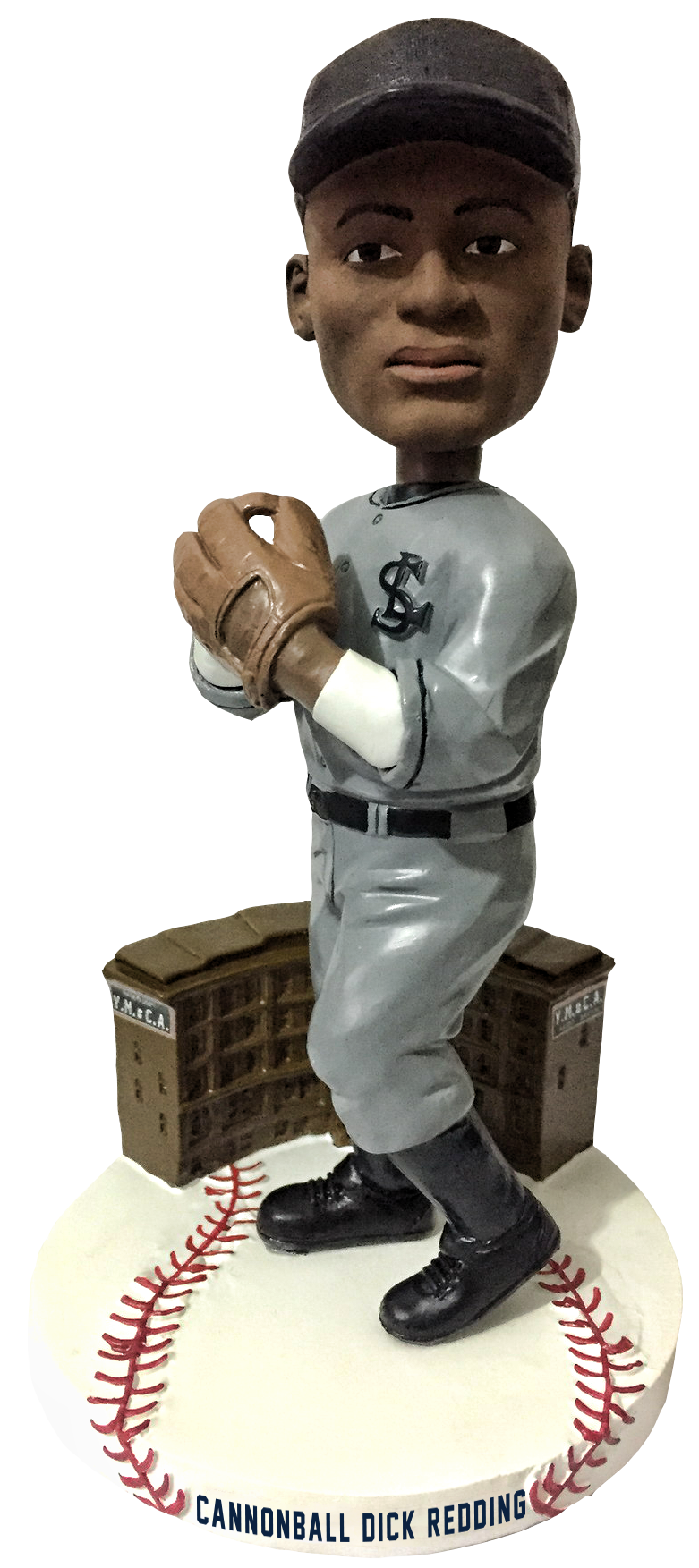
Anyway, browsing around the site, I ended up at the site store looking at bobble heads. I am not a bobble head collector, but was intrigued to see who they had selected for a set they call the Negro Leagues Centennial Team. If you scroll through the collection, you'll see that it's a who's who of Negro League baseball. Cool Papa Bell, Josh Gibson, Satchel Page, Biz Mackey, Pop Lloyd, Buck O'Neil. I mean they're all there. And then I saw a name that surprised me: Cannonball Dick Redding.

Now, I've heard of Dick Redding, but only because of one game. In April, 1919, while George Gibson was managing the Toronto Maple Leafs, they hosted an exhibition series with the Pittsburg Colored Stars of the Buffalo City League. Pitching for the Colored Stars in the first game of that series was one, Dick Redding. In front of 2,500 fans, Redding, who was described then as being as fast as Walter Johnson, and has since been described as being faster than Bob Feller, held Toronto to 5 hits, and led his team to an easy 7-0 shutout. The Globe covered the series, and made it very clear that Redding was good. But I had no idea just how good.

Richard 'Dick' Redding, was born in 1891 in Atlanta, GA, and is considered by some to be the fasted pitcher ever to compete in the Negro Leagues, which is obviously where the nickname 'Cannonball' originated from.

Held out of the Major Leagues because of the colour of his skin, Redding instead terrorized the Negro League circuit for for a little over two decades, from 1911 until 1932. Amidst the prime of his career, Redding's career was interrupted by WWI. He enlisted in the US Army, and saw combat in France, but was lucky enough to return to US soil after the war, and continue his baseball career. Redding had a reputation as one of the hardest throwers in the league, which was coupled with a willingness to use that speed to knock batters down to assert his dominance.

During parts of his playing career, Redding also took on the role as manager, managing the New York Bacharachs in 1921. He pitched to a 17-12 record that season, and in 1922 went back to being a player, only. As with all athletes, Redding's skills began to deteriorate as his age caught up with him. But he was still a big name in Negro League baseball, and had significant experience. He parlayed this into another managing opportunity, managing the Brooklyn Royal Giants for six seasons, from 1927-1932.

"Cannonball" Dick Redding passed away in 1948, in Islip, New York, leaving behind a legacy as a hard thrower and a fierce competitor, while also being good natured and easy going. According to Buck O'Neil, he "was a nice fellow, easy going. He never argued, never cursed, never smoked as I recall; I never saw him take a drink."

From 1911-1932, there were 34 no-hitters thrown in Major League Baseball. Against all levels of competition during his career, Redding is credited with 30 no-hitters himself, and as many as 7 in a single season. To have this level of success, on top of being compared with Walter Johnson and Bob Feller, to play and to manage over the course of a couple decades, and to serve in World War I, and to remain relatively unknown, at least to this baseball fan, is unthinkable. And embarrassing.

And yet, this is what's great about baseball. There's always more to learn!

If you're interested in learning more, the following sources were used for this post:

https://negroleagueshistory.com/blog/
http://www.nlbemuseum.com/history/players/redding.html
https://en.wikipedia.org/wiki/Dick_Redding

Thursday, March 26, 2020

Five Best Catchers in Pirates History

This one's pretty straightforward, I think.

MLB.com asked each of their beat reporters to rank their top 5 catchers in their franchise's history.

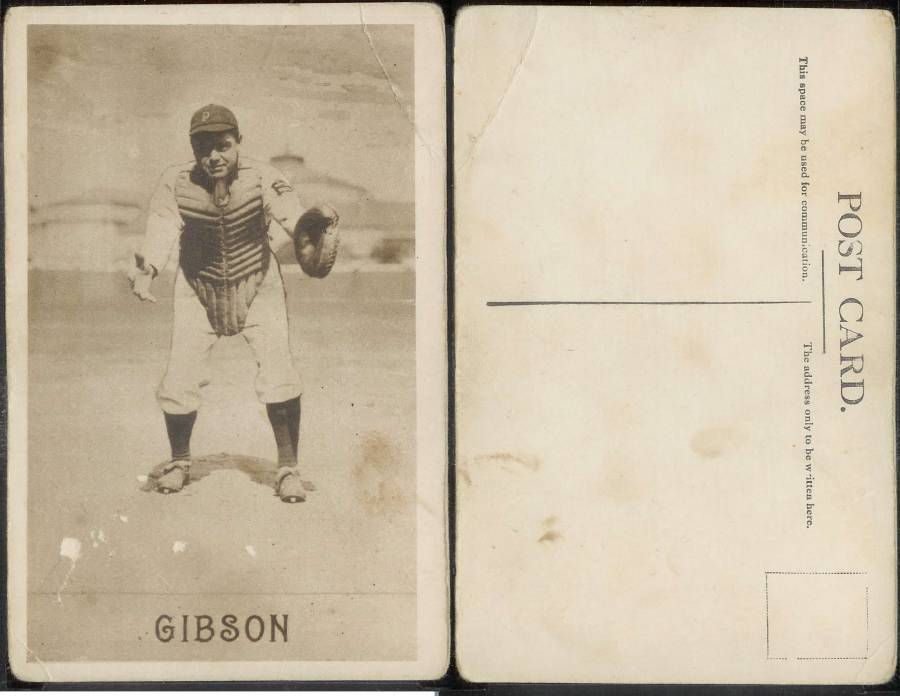
Otherwise, this was really just an excuse to show a 1910 PC796 Sepia post card showing the one and only George Gibson. Check out the sweet mitt, and complete lack of shin guards!

You can go here to see the full article for the Pirates. If you're in a hurry, just skip one-through-three, and five.

Monday, March 23, 2020

Opening day

The 2020 MLB season would be opening this Thursday, if not for the postponement as a result of the global pandemic we are all experiencing right now.

Since we can't quite start to look forward to opening day just yet, I figured instead we could look back at opening day. Or rather, opening days.

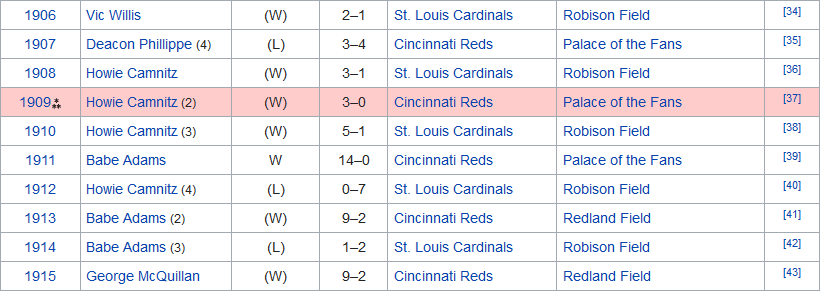
From 1906 to 1915, George Gibson made 10 consecutive opening day starts at catcher.
In those contests, the Pirates went 7-3.


Curiously, they never opened at home. In fact, if you look at the whole chart (found here), they didn't open at home from 1894 until 1953. Surely there's a reason. I know that before Forbes Field was built, they often had Spring flooding issues at their park(s), but over 50 years of opening on the road? Wow.

In case you were wondering, George's 10-consecutive opening day starts still stands as a Pirates record.

Want another interesting opening day fact?

Here's one:

In light of opening day having been postponed, McFarland is offering up a pretty awesome deal. Order any of their baseball books between today and April 5th, and you can use the coupon code POSTPONED40 to save 40% off of your order!

Obviously I'm telling you this because I think you should order the newly released biography about George "Mooney" Gibson, but why stop there? McFarland has published some absolutely phenomenal baseball books, written by some excellent authors. This is a great opportunity to get a jump start on acquiring some books for your Summer reading list.

And I'm not just saying that. I put an order in for 5 books already, and might not be done yet!


Stay safe, everyone, and thanks for reading!

Richard.

Saturday, March 14, 2020

Mail Day!

Earlier this week, I received an email from UPS telling me a parcel would be dropped off at my house on Friday. Since I live in Canada, an email from UPS is rare at the best of times, notwithstanding the fact that I hadn't ordered anything recently. I almost deleted the email, just assuming it was some kind of phishing email.

Instead, I opened it. After carefully reading over the email, I was intrigued. It looked legit. I didn't click any of the links in the email, but instead went to the UPS site directly and pasted in the tracking number.

Sure enough, a parcel was mailed from North Carolina, and was destined for my house.
The publisher of our book, McFarland, is located in North Carolina. Coincidence?

Nope!

Marty and I knew the book was nearly published. We submitted our final edits last Monday (March 9th) and were told "it's imminent." We assumed that meant a few weeks. Turns out it meant a few days!

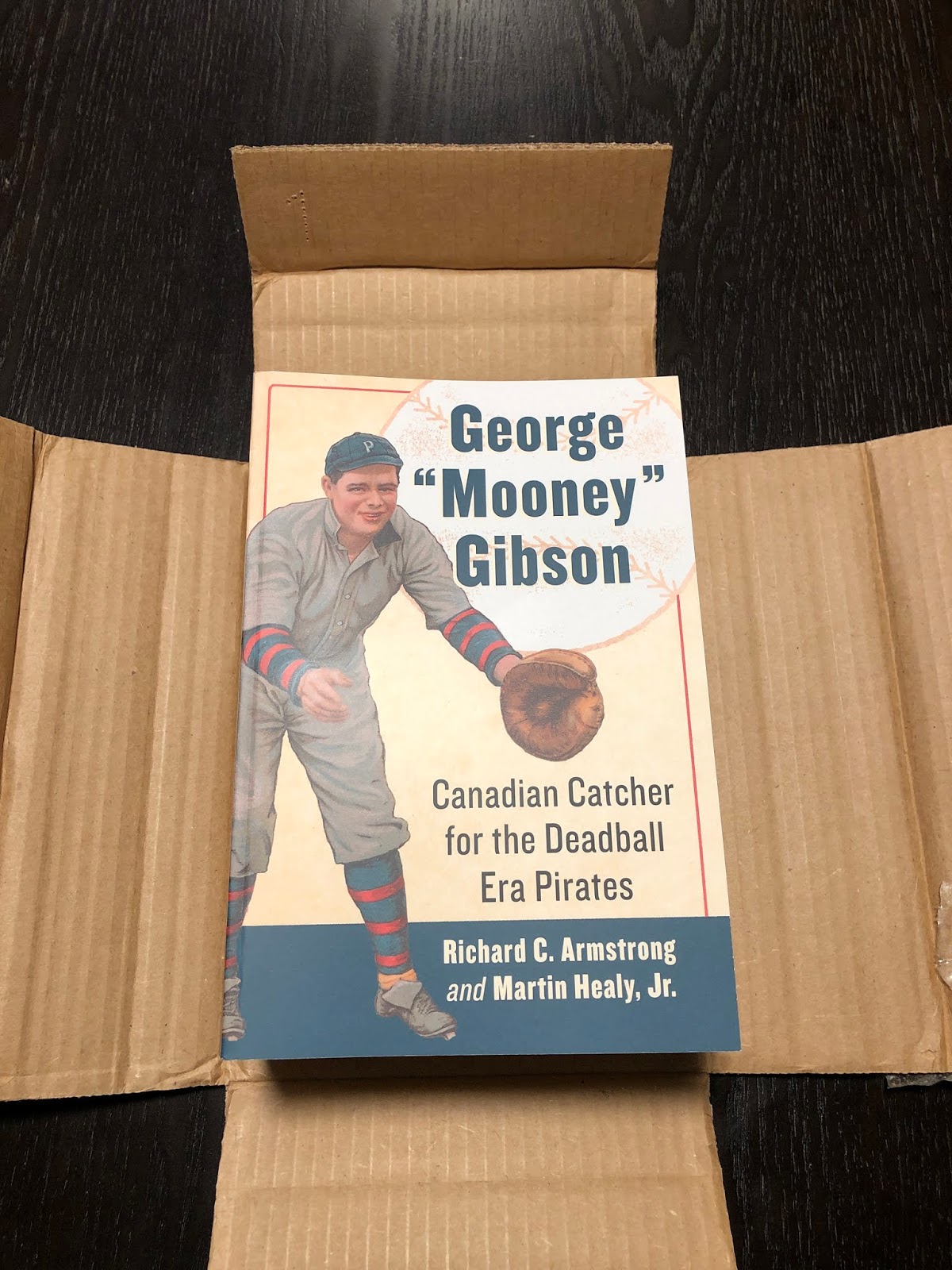
UPS emailed me again on Friday, just before lunch, to confirm the parcel had been delivered. I left work at lunch, came home, and sure enough, here is what I found:


Five copies of our book!

I immediately called Marty, unintentionally spoiling the surprise for him, as 5 books were headed his way too, but UPS hadn't tipped him off. Later in the day, he also got his copies.

What a day.

Pretty cool feeling to work on something for years, never really know if it'll see the light of day, and then receive an actual physical copy in your mailbox, and somewhat by surprise, too.

Special thanks to McFarland for taking on the project, but extra props for knowing how to make this a memorable experience for a couple of first-time authors.

Of course that also means the book is out!

Last night, Marty and I put in a large order for the book, and in the next few weeks we hope to have it for sale at the Canadian Baseball Hall of Fame and some local book stores around the London area.

You can also order the book directly from McFarland, and while you're at it stock up on some of their other great baseball books.

This is a free demo result from the Wayback Machine Downloader. Click here to download the full version.